SAMURAI - NIMS Researchers Database

HOME > Profile > UMEYAMA, Daiki

Research

Society memberships

日本化学会, その他

Research Center for Macromolecules and Biomaterials
Title

Molecular-Ion-Based Electronic Structure Engineering of Organic-Inorganic Hybrid Materials

Keywords

Organic-inorganic hybrid materials, molecular ions, band structures, optoelectronics

Overview

 Organic-inorganic hybrid materials, such as MOFs and halide perovskites, possess distinctive properties arising from molecular designability, including porosity, processability, and structural flexibility, and are attracting considerable attention as next-generation functional materials.
 To fully exploit these characteristics in electronic and optoelectronic devices, precise control of their optoelectronic properties is essential, which in turn requires rational engineering of their electronic band structures. However, methodologies for such band-structure engineering remain underdeveloped. In particular, strategies for combining the localized electronic states characteristic of organic molecules with the dispersive bands characteristic of inorganic solids at the frontier energy levels remain largely unexplored.
 To address this challenge, we use molecular ions not merely as structural components of crystals, but as “electronic-structure units” for actively engineering the frontier electronic structure of organic-inorganic hybrid materials.

Novelty and originality

Combining localized molecular orbitals with dispersive inorganic bands at the frontier energy levels
Using molecular ions as “electronic-structure units”
Exploiting molecular-orbital energy, symmetry, and topology for band-structure engineering
Creating new hybrid semiconductors that combine localized and dispersive electronic states

Details

image

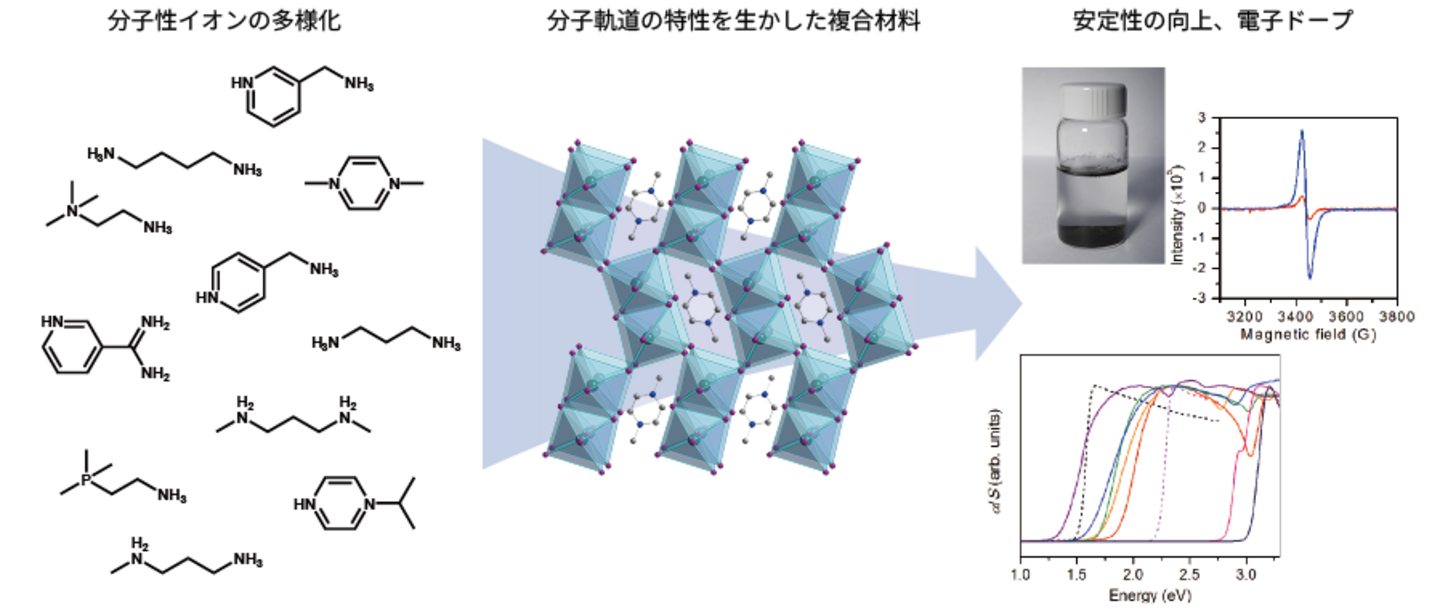
 By expanding the inorganic framework of lead-halide perovskites to accommodate electron-accepting organic molecules, we realized an electronic structure in which a conduction band composed of localized molecular orbitals coexists with a dispersive valence band derived from the lead-halide framework. This unusual band structure, distinct from that of conventional halide perovskites, enables electrons and holes to reside in the organic and inorganic components, respectively, while retaining fundamentally different electronic characteristics.

image

 We have also demonstrated that the coordination environment of Pb(II) can be controlled through the design of molecular anions. By preserving the isotropic character of the Pb 6s orbital while selectively promoting its interaction with molecular orbitals, we achieved the coexistence of a wide band gap and a highly dispersive valence band. This study further revealed that not only the energy levels of molecular orbitals, but also their orbital symmetry and topology, are key design parameters governing the band structures of hybrid solids.

Summary

Creating new electronic structures by combining localized molecular orbitals with dispersive inorganic bands
Controlling band structures through molecular energy levels, orbital symmetry, and coordination geometry
Establishing a new materials chemistry for the rational band-structure engineering of organic-inorganic hybrid materials

この機能は所内限定です。
この機能は所内限定です。

▲ Go to the top of this page