SAMURAI - NIMS Researchers Database

HOME > Profile > SUKEGAWA, Hiroaki

Research

Keywords

スピントロニクス,ホイスラー合金,ハーフメタル

PublicationsNIMS affiliated publications since 2004.

Books
Presentations

Society memberships

日本磁気学会, 応用物理学会, 日本金属学会, Institute of Electrical and Electronics Engineers

Research Center for Magnetic and Spintronic Materials
Title

Giant Tunnel Magnetoresistance Effect Exceeding 630% at Room Temperature

Keywords

Tunnel Magnetoresistance Device, TMR, MRAM, Magnetic Sensor

Overview

Tunnel magnetoresistance (TMR) devices (or magnetic tunnel junctions, MTJs) using magnetic thin films are used in hard disk drive (HDD) read heads and as memory bits in magnetoresistive random access memories (MRAMs), a type of non-volatile memory. A TMR device is one in which the electrical resistance of an ultrathin barrier sandwiched between magnetic layers changes; the greater this resistance change (TMR ratio) at room temperature (RT), the easier it is to achieve high device performance. However, since the report of a 604% RT-TMR ratio in 2008, no further improvements in the TMR ratio had been achieved, even in laboratory demonstrations, and significant progress in the short term did not appear likely. Therefore, by utilizing the latest magnetic thin-film fabrication technologies and refocusing efforts on improving the crystal quality at the interface between the magnetic layer and the barrier layer of the TMR device, we aimed to achieve a TMR ratio at RT higher than previous values.

Novelty and originality

● Establishment of a method for fabricating high-quality single-crystal films (epitaxial growth)
● Setting a new record for the room-temperature tunnel magnetoresistance (TMR) ratio
● Observation of a giant TMR ratio oscillation phenomenon

Details

image

image

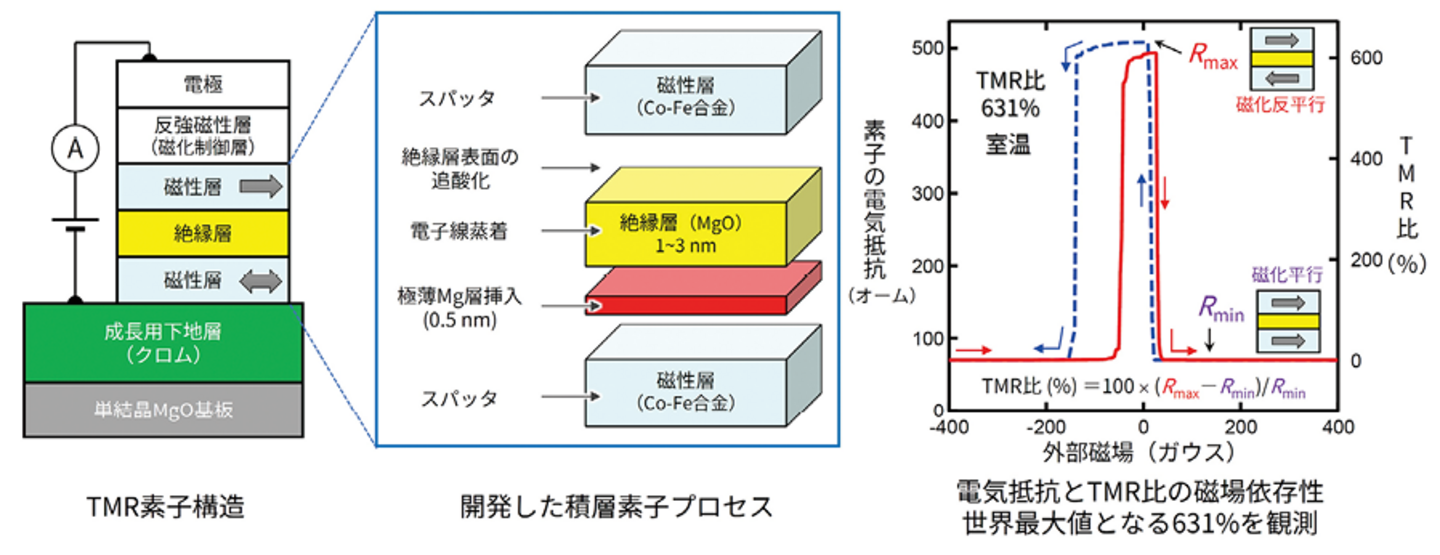
We achieved an improvement in the TMR ratio at RT by precisely controlling the interface between the magnetic layer and barrier of a tunnel magnetoresistance (TMR) device. Specifically, as shown in the figure on the left, we fabricated thin-film devices using epitaxial growth techniques to enhance their quality. By improving the crystallinity of the interfaces at the atomic scale, such as by inserting a ultra-thin magnesium layer at the lower barrier interface and additional oxidation process at the upper barrier interface, we succeeded in realizing a single-crystal device with sharp interfaces on both the upper and lower sides. As a result, we achieved a TMR ratio of up to 631% at RT, setting a new world record for the first time in 15 years (see figure on the right). Furthermore, we clearly observed a phenomenon in which the TMR ratio oscillate periodically as a function of the barrier thickness (TMR oscillation), and found that the oscillation amplitude is as large as 141% (previously, a few percent to several tens of percent). By investigating the mechanism of this oscillation phenomenon and clarifying its relationship with the TMR ratio, we expect to achieve even higher TMR ratios at RT. The demonstration of this high RT TMR ratio is expected to lead not only to applications in high-sensitivity magnetic sensors, but also to its use in new memory technologies that would have been difficult to achieve with conventional TMR ratio levels.

Summary

● Establishment of a method for fabricating high-quality single-crystal films (epitaxial growth)
● Setting a new record for the room-temperature tunnel magnetoresistance (TMR) ratio
● Observation of a giant TMR ratio oscillation phenomenon

この機能は所内限定です。
この機能は所内限定です。

▲ Go to the top of this page