HOME > Profile > HASE, Masashi
- Address
- 305-0047 1-2-1 Sengen Tsukuba Ibaraki JAPAN [Access]
Research
- Keywords
Antiferromagnetic materials; Inelastic neutron scattering; Magnetization; Parameter estimation; Quantum theory
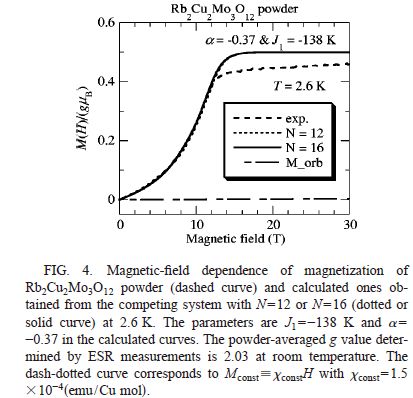
In this paper,we could not reproduce well the experimental susceptibility and magnetization by our calculation technique. Accordingly,it is necessary to calculate susceptibility and magnetization of the competing system with J1, J2, and extra interactions in the case that 20 =< N and to evaluate susceptibility and magnetization of the infinit chains.
Phys Rev B 73 (2006) 104419.
PublicationsNIMS affiliated publications since 2004.
Research papers
- TAKEHANA, Kanji, OSHIKIRI, Mitsutake, 高増正, 木戸義勇, HASE, Masashi, 内野倉國光. Magnetostriction Measurements of CuGeO3 in High Magnetic Fields. J.Magn.Magn.Mater. (1998) 699-700
- Noriki Terada, Hiroaki Mamiya, Hiraku Saito, Taro Nakajima, Takafumi D. Yamamoto, Kensei Terashima, Hiroyuki Takeya, Osamu Sakai, Shinichi Itoh, Yoshihiko Takano, Masashi Hase, Hideaki Kitazawa. Crystal electric field level scheme leading to giant magnetocaloric effect for hydrogen liquefaction. Communications Materials. 4 [1] (2023) 13 10.1038/s43246-023-00340-z Open Access
- 竹端寛冶, 高増正, HASE, Masashi, 木戸義勇, 内野倉國光. Spin-phonon coupled modes in the incommnsurate phases of CuGeO3. Journal of Physical Society of Japan. (2001) 3391
Books
Proceedings
- HASE, Masashi, 江袋佑太, 黒江晴彦, 松本正茂, 松尾晶, 金道浩一, James R. Hester, 佐藤卓, 山崎展樹. Erratum: Magnetism of the antiferromagnetic spin-3/2 dimer compound CrVMoO7 having an antiferromagnetically ordered state. PHYSICAL REVIEW B. (2018) 139901- 1
- Masashi Hase, Andreas Dönni, Vladimir Yu. Pomjakushin, Kazuhiro Nawa, Daisuke Okuyama, Taku J. Sato, Shinichiro Asai, Takatsugu Masuda. Magnetic Excitations of the Spin-Chain Compound Tb<sub>3</sub>RuO<sub>7</sub>. Proceedings of the 29th International Conference on Low Temperature Physics (LT29). (2023) 10.7566/jpscp.38.011129
- Masashi Hase, Masashige Matsumoto, Akira Matsuo, Koichi Kindo. Magnetic properties of the antiferromagnetic spin-1/2 tetramer compound CuInVO5. J. Phys.: Conference Series. (2018) 012100-1-012100-7 10.1088/1742-6596/969/1/012100
Presentations
- HASE, Masashi. Magnetic properties of the antiferromagnetic spin-1/2 tetramer compound CuInVO5. 28th International Conference on Low Temperature Physics (LT28). 2017
- HASE, Masashi, Shinichiro Asai, Minoru Soda, Daichi Kawana, Takatsugu Masuda, Shinichi Itoh, Tetsuya Yokoo, KOHNO, Masanori, Vladimir Yu. Pomjakushin, DOENNI, Andreas, Martin Rotter. Neutron scattering studies on NdCrTiO5 and NdCrGeO5 having spin-3/2 antiferromagnetic alternating chains of Cr3+ spins. The International Chemical Congress of Pacific Basin Societies 2025 (Pacifichem 2025). 2025
- HASE, Masashi, DOENNI, Andreas, Vladimir Yu. Pomjakushin. Magnetic Refrigeration Oxides Containing Rare-Earth Element and Ru for Hydrogen Liquefaction. The 14th International Conference on High-Performance Ceramics (CICC-14). 2025 Invited
Misc
- K. Tsubura, K. Imamura, A. Takamine, S. Akimoto, M. Ito, K. Kikuchi, R. Mitsuyasu, A. Gladkov, M.Tajima, S. Go, M. Mukai, M. Doi, M. Nishimura, T. Yamamoto, H. Endo, HASE, Masashi, K. Kawata, H. Nishibata, Y. Ichikawa, H. Ueno, Y. Matsuo. Fluorescence detection of the highly energetic radioactive Rb beams stopped in an optical cryostat at HIMAC. RIKEN Accelerator Progress Report. 55 (2022) 91
- M. Ito, K. Imamura, S. Akimoto, A. Takamine, K. Kikuchi, R. Mitsuyasu, T. Miwa, A. Gladkov, M.Tajima, S. Go, M. Mukai, H. Endo, S.Sasamori, S. Takahashi, Y. Fukuzawa, HASE, Masashi, K. Kawata, A. Kitagawa, T. Wakui, H. Ueno, Y. Matsuo. Measuring the stopping position of the energetic radioactive Rb beams in superfluid helium. RIKEN Accelerator Progress Report. 56 (2023) 105 Open Access
- 長谷 正司. PSIとANSTOでの滞在を気持ちよく過ごすために. 波紋. 35 [1] (2025) 23-25 Open Access
Society memberships
日本物理学会, 日本中性子科学会
Awards
- 富山県未来財団 富山賞(1995年),日本金属学会 奨励賞(1998年) ()
Research Center for Materials Nanoarchitectonics (MANA)
Research on Magnetic Materials Using Neutron Diffraction under an Applied Magnetic Field
neutron diffraction, magnetic field, magnetic material, quantum spin system, quantum material
Overview
In neutron diffraction, magnetic structures (the arrangements of magnetic moments) can be investigated, but conventional neutron diffraction cannot be applied to the paramagnetic state, in which the magnetic moments are not ordered. When a magnetic field is applied to a paramagnetic state, field-induced magnetic moments appear parallel to the applied field, producing magnetic Bragg peaks. By analyzing these magnetic Bragg peaks, the field-induced magnetic moment at each site can be determined. By combining this information with other experimental results, such as magnetization and specific-heat measurements, we can obtain more accurate information about the magnetic interactions within the material. This can contribute to the development of magnetic materials. To date, we have successfully demonstrated the direct observation of eigenstates in quantum mechanics and the determination of magnetic models.
Novelty and originality
It enables us to obtain information about the paramagnetic state that could not be accessed by conventional neutron diffraction.
By applying the magnetic field perpendicular to the neutron scattering vector, the sensitivity can be enhanced by approximately a factor of four.
It enables us to obtain more accurate information about the magnetic interactions within the material. Conventional methods based on magnetization and specific-heat measurements have the limitation that the magnetic interactions cannot always be determined uniquely.
Details
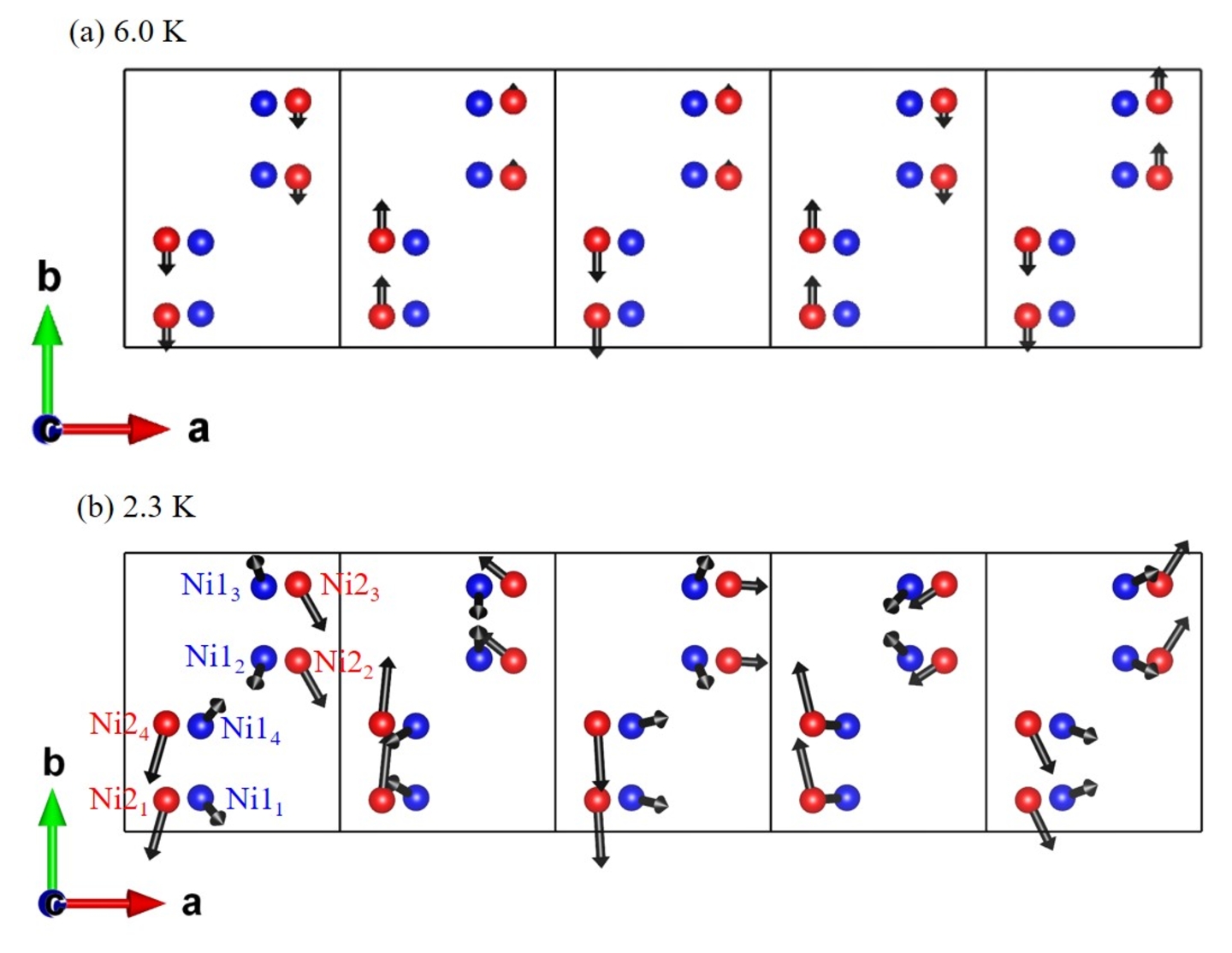
We present an example of applying this method to the quantum spin system Ni2V2O7. The left figure shows the magnetic structures in zero magnetic field. Two successive magnetic transitions occur at TN1=6.7 K and TN2=5.7 K. At 6.0 K, between TN1 and TN2, only the Ni2 moments of the two types of Ni moments become ordered, resulting in a spin-density-wave structure. At 2.3 K, below TN2, both types of Ni moments become ordered, giving rise to an elliptical cycloidal structure.
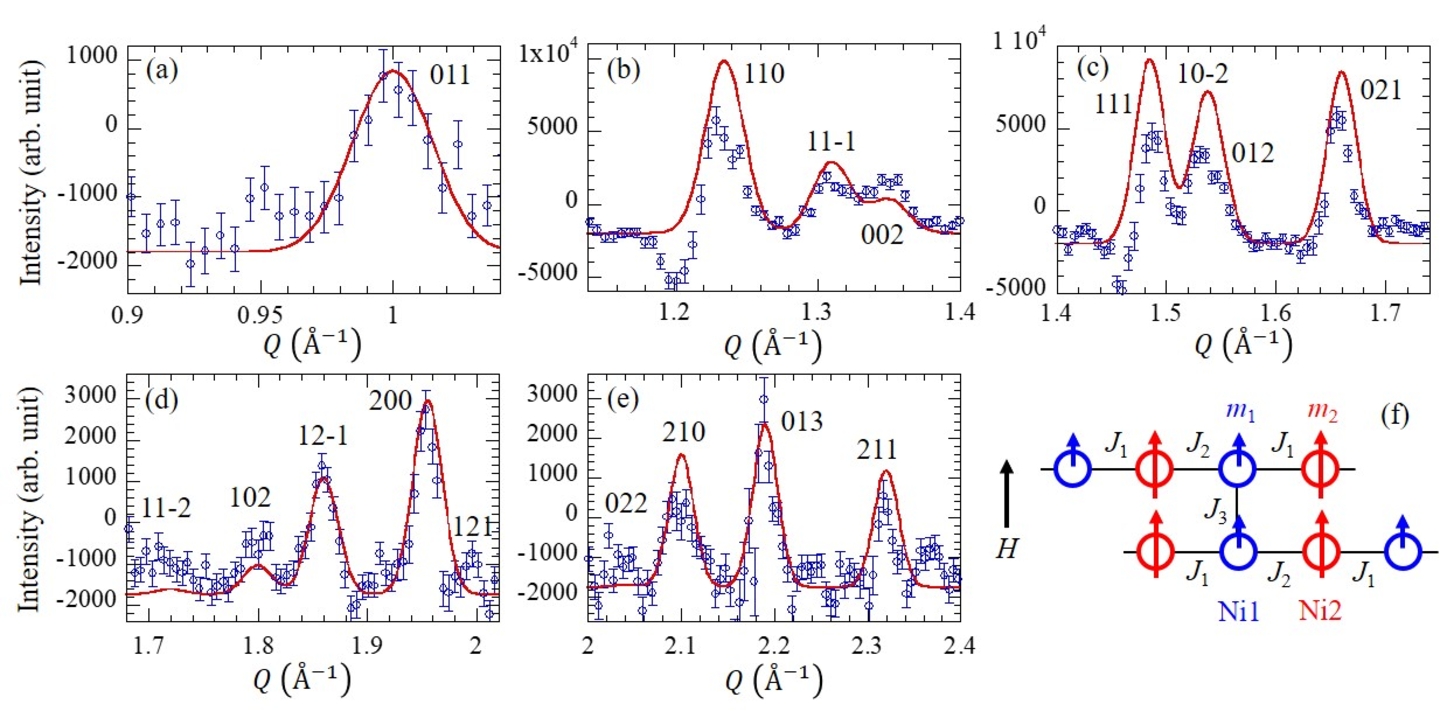
To understand such complex magnetic structures, it is important to obtain accurate information on the magnetic interactions. We therefore performed neutron diffraction measurements under a magnetic field. This experiment takes advantage of the fact that this material becomes paramagnetic when a magnetic field of more than 80,000 gauss is applied. The results are shown in the right figure. At a magnetic field of 100,000 gauss, the field-induced moments of Ni1 and Ni2 were found to be 0.3 and 1.9 muB (Bohr magnetons), respectively. These results are consistent with the dimer–monomer model proposed in previous studies.
Summary
Because it enables more accurate acquisition of information on magnetic interactions within materials than conventional methods, it can contribute to the research and development of magnetic materials, quantum materials, quantum liquid-crystal materials, and other related materials.