HOME > Profile > YOSHIO, Masafumi
- TEL
- 029-860-4728
- Address
- 305-0047 1-2-1 Sengen Tsukuba Ibaraki JAPAN [Access]
Accepting Students
External affiliations
- Hokkaido University, Graduate School of Chemical Sciences and Engineering, Nano-Assembled Materials Chemistry Laboratory, Guest Professor
Research
- Keywords
Soft Actuators, Supramolecular Polymers, Liquid Crystals, Self-Assembled Nanofibers, Organic Ion Conductors, Organic Semiconductors, Mechanochromic Luminescence Materials, Flexible Porous Materials
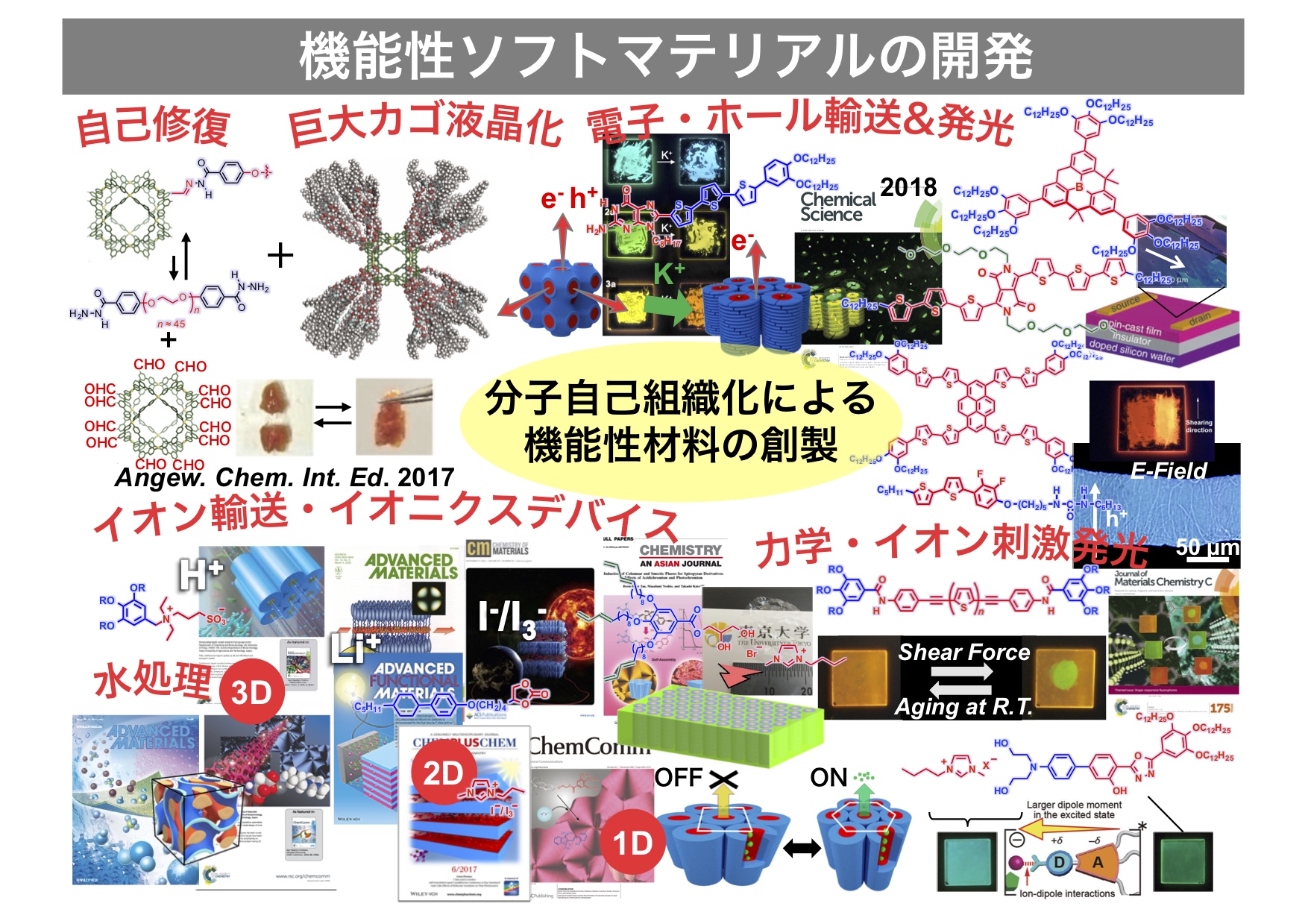
"Molecular Mechatronics" is a concept that integrates "Molecular", "Mechanics", and "Electronics". It is an interdisciplinary research field that seeks to create new materials, devices, and technologies at the interfaces of these fields, with the aim of transforming and advancing existing materials and technologies. We develop innovative electroactive organic and polymeric materials and device technologies for applications including haptic feedback devices for virtual reality (VR), micro-vibration energy harvesters, and stress, friction, optical, and molecular sensors (see Figure). Based on the synthesis of uniquely designed molecular materials, we precisely control hierarchical ordered structures and their organization across length scales ranging from nanometers to centimeters. Through this structural control, we aim to achieve high-speed transport of ions, electrons, photons, and matter, as well as efficient energy conversion, ultimately creating high-performance energy-conversion devices such as actuators that convert electrical energy into mechanical energy. We develop a wide range of self-assembled materials, including ion-active nanostructured liquid crystals, liquid-crystalline semiconductors incorporating electronically active π-conjugated structures, and block copolymers capable of forming electrets. Our research also encompasses flexible metal–organic framework (MOF) materials, flexible thin films of covalent organic frameworks (COFs) exhibiting ionic and electronic conductivity, thermoplastic low-molecular-weight physical gels, and natural polysaccharide-based polymer gels. Our group conducts integrated research and development spanning the entire process from molecular design and synthesis of materials to structural and physical-property characterization, circuit design, and device fabrication and evaluation. We also place strong emphasis on operando structural analysis using synchrotron radiation facilities and on elucidating device operating mechanisms through computational science. Researchers in our group can acquire a broad range of experimental and analytical techniques, including organic and polymer synthesis, chromatography, nuclear magnetic resonance (NMR) spectroscopy including pulsed-field-gradient measurements for ion diffusion, thermal analysis, fluorescence spectroscopy, electrochemical impedance spectroscopy, dielectric relaxation measurements, electrical conductivity measurements, time-of-flight charge-carrier mobility measurements, transistor device fabrication and evaluation, ferroelectric measurements, electric-field poling techniques, laser Doppler vibrometry, electron microscopy and atomic force microscopy, wide-angle and small-angle X-ray scattering, viscoelastic measurements, and tensile testing.
We proposed a new design concept for creating “ion highways” by harnessing the molecular alignment of liquid crystals. This concept enabled the development of a flexible actuator that delivers rapid bending at up to 150 Hz under a low driving voltage of only 2 V (see Figure), and its unprecedented functionality was demonstrated in a ring-shaped haptic device. The technology paves the way toward haptics that allow users to experience distant objects as if they were being touched directly. It could enable realistic remote palpation in telemedicine and immersive virtual experiences, opening new possibilities for richer and more engaging human–machine interactions.
PublicationsNIMS affiliated publications since 2004.
Research papers
- 吉尾 正史. イオン伝導性液晶/高分子コンポジットを活用した高周波振動ソフトアクチュエータ. EKISHO. 29 [1] (2025) 1-7 Open Access
- Chengyang Liu, Masafumi Yoshio. Ion-conductive liquid-crystalline gels for enhanced soft actuator applications. Materials Today Chemistry. 46 (2025) 102715 10.1016/j.mtchem.2025.102715
- 吉尾 正史. 液晶性イオン伝導体を用いた電気駆動ソフトアクチュエータの開発. 液晶. 27 [3] (2023) 190-197
Presentations
- YOSHIO, Masafumi. Nanostructured Liquid Crystal Engineering for Efficient Ion Transport and Actuation. Japan–France Symposium on the Frontiers of Future Materials Design. 2026
- YOSHIO, Masafumi. Nanostructured Liquid-Crystalline Electrolytes for Ionic Electroactive Soft Actuators. The 30th International Liquid Crystal Conference (ILCC 2026). 2026
- 吉尾 正史. イオン性液晶高分子アクチュエータの創出. 日本化学会 第106春季年会(2026). 2026
Misc
- 吉尾 正史. イオン伝導性液晶/高分子コンポジットを活用した高周波振動ソフトアクチュエータ. EKISHO. 29 [1] (2025) 56-62 Open Access
- 吉尾 正史. 研究現場最前線 物質・材料研究機構 機能性材料研究拠点 吉尾研究室. 液晶:日本液晶学会誌. (2020) 132-133
- 吉尾 正史. 変革というミッション. 高密度共役の科学ニュースレター. 22 (2022) 0
Published patent applications
Society memberships
The Society of Polymer Science, Japan, The Japanese Liquid Crystal Society, The Chemical Society of Japan
Awards
- 日本液晶学会業績賞 (2026)
- 高分子学会三菱ケミカル賞 (2024)
- 日本液晶学会論文賞 (2024)
- NIMS理事長賞研究奨励賞 (2024)
- 日本液晶学会論文賞 (2019)
- 東京大学工学部ベストティーチングアワード (2014)
- 高分子学会日立化成賞 (2012)
- 日本液晶学会奨励賞 (2007)
- 国際液晶学会ポスター賞 (2002)
Funds
- 基盤研究(B) ジャイロイド構造膜を基盤とする高性能ソフトアクチュエータの創出 (2026)
- 学術変革領域研究(A)計画班 高度π分子分極システムの創製とアクチュエータ・センサへの応用 (2025)
- 村田学術振興・教育財団 キュービック液晶高分子アクチュエータおよび触覚デバイスの開発 (2024)
- 戦略的創造研究推進事業さきがけ 液晶分子配列を生かした未来メカトロニクス材料の創出 (2023)
- 池谷科学技術振興財団 革新的電気活性ポリマーおよびウェアラブル触覚デバイスの開発 (2023)
- 基盤研究(B) 無水プロトン伝導性液晶高分子膜の創製と燃料電池への応用 (2021)
- 基盤研究(B) イオン液体をナノ組織化した液晶アクチュエータの創成 (2021)
- 村田学術振興 ナノ相分離液晶構造を有する無水プロトン伝導材料の創製 (2017)
- 村田学術振興 ナノ相分離液晶構造を有する無水プロトン伝導材料の創製 (2016)
- 挑戦的萌芽研究 三次元ジャイロイドナノ空孔を有する液晶高分子膜の創製 (2015)
- 新学術領域研究 電場感応性π共役液晶材料の構築 (2015)
- 野口研究所 プロトンー電子混合伝導性液晶材料の創製 (2015)
- 新学術領域研究 電子・光機能を有する電場感応答性分子集合体の創製 (2013)
- 若手研究(A) 液晶の自己組織化を活用する無水プロトン伝導体の創製 (2013)
- 挑戦的萌芽研究 液晶性グラフェン半導体エラストマーの開発 (2012)
- クリタ水・環境科学振興 海水脱塩化のための液晶ナノ構造高分子膜の開発 (2011)
- 村田学術振興 ナノファイバー形成能を有する有機無機ハイブリッド半導体の構築 (2011)
- 若手研究(B) 導電性分子ファイバーの開発と電場配向制御 (2006)
- 若手研究(B) イオン性液体を有する液晶性有機/無機ハイブリッド高分子ナノ材料の開発 (2003)
Research Center for Macromolecules and Biomaterials
Creation of Next-Generation Energy Conversion Materials and Devices Leveraging Molecular Ordering
Supramolecular Polymers,Liquid Crystals,Organic Semiconductors,Actuators,Soft Robotics, Haptics,Photoelectric Conversion Devices
Overview
Building on the synthesis of novel polymeric materials, such as ionic liquid-crystalline network polymers and ferroelectric π-conjugated polymers, and the precise control of their nanostructures and molecular alignment, we are developing next-generation smart devices, including electric-field-driven soft actuators exhibiting bending and contraction/extension motions, haptic devices, soft robots, piezoelectric sensors, and photoelectric conversion devices. By integrating the lightweight, stretchable, flexible, self-healing, shape-memory, and biodegradable properties of polymers with electronic, ionic, and optical functionalities, we aim to create novel substances, materials, and devices that break through conventional concepts and limitations.
Novelty and originality
● Development of Liquid-Crystalline Polymer Actuators with High-Speed Vibration at 100 Hz and High Output Force of 5 gf under 2 V
● Development of Self-Extinguishing, Nonvolatile Nanostructured Electrolytes with Fast Lithium-Ion Conductivity
● Design of Photoelectric Conversion Devices Utilizing the Bulk Photovoltaic Effect in Ferroelectric π-Conjugated Semiconductors
● Creation of Metal-Complex Supramolecular Polymers with Self-Healing and Shape-Memory Functions
Details
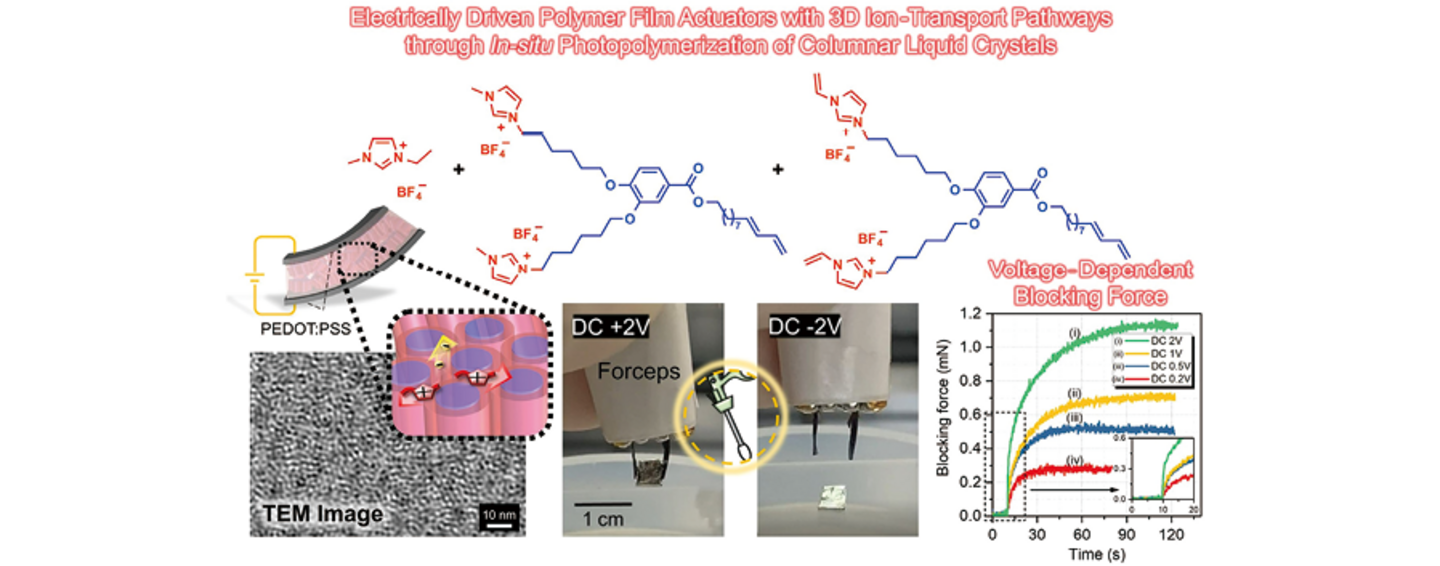
With the aim of developing haptic devices and soft robots that combine high safety and energy efficiency with the seemingly conflicting properties of high-speed vibration and high output force, we developed an ionic-conductive liquid-crystalline polymer film actuator. We designed and synthesized photo-crosslinkable ionic molecules with a wedge-shaped molecular structure. Through self-assembly with a small amount of ionic liquid, these molecules formed a room-temperature columnar liquid crystal with a nanophase-separated structure containing three-dimensionally interconnected, fast ion-conduction pathways. UV polymerization within the liquid-crystalline phase produced a tough and flexible polymer film that retained the original nanostructure. Transmission electron microscopy (TEM) observations of ultrathin sections successfully visualized the nanoscale ion-conduction pathways.
A trilayer actuator device was fabricated by sandwiching the liquid-crystalline polymer electrolyte film between two doped polythiophene-based conducting polymer electrodes (PEDOT:PSS). Application of a 2 V voltage produced large, highly durable bending deformation. By designing a circuit that caused two actuator elements to bend inward, we developed miniature tweezers capable of gently grasping objects. The output force could be controlled by varying the applied voltage over the range of 0.2–2.0 V. Furthermore, we discovered a novel shape-memory function, not observed in conventional materials, in which the deformation was retained even after the voltage was switched off. These actuators are expected to find applications in VR haptic technology, walking-assistance sensors for people with visual impairments, medical devices, and other soft robotic systems.
Summary
Ionic liquid-crystalline polymer actuators are promising as a new class of materials capable of simultaneously achieving the seemingly conflicting functions of high-speed, large deformation and high output force, opening up a wide range of potential applications. In the future, we aim to expand the materials exploration space, develop unprecedented functionalities such as resistance to extreme environments, including space, and self-healing, and establish a comprehensive database of these materials and their properties, thereby contributing to the realization of a well-being society.